Laigo GPT · Use Case 02
How secure AI without data outflow relieves decision-makers and enables better decisions.
·7 min read
The short answer
A locally operated AI can prepare decision-relevant information from complex matters in a structured way and make indications of possible discrepancies visible. The professional assessment, the legal classification and the final approval remain entirely with people.
The time span refers to the described use case. It is not a blanket performance guarantee; the actual effect depends on documents, data quality, configuration and organizational integration.
New series
A concrete process. A real metric. Clear boundaries.
Starting point
Every legally binding signature is a decision that carries responsibility. Before a contract, an addendum, an expert report or a complex administrative matter, very different pieces of information often have to be brought into a traceable context within a short time.
Existing agreements, legal requirements, calculations, expert opinions and earlier decisions must be considered before the approval. It is precisely this step that becomes the bottleneck – not because those responsible work too slowly, but because they take the significance of their signature seriously.
When approvals are delayed, projects stall, contracts are concluded later and follow-up processes lose time. At the same time, the pressure grows on those who ultimately have to sign.
The AI prepares the decision. The human makes it. According to its product description, Laigo GPT processes content locally within the protected network and is meant to create a traceable basis of information – not to shift responsibility.
The risk window
The critical moment lies before it: in fragmented documents, diverging contract versions, calculations that are hard to trace and information hidden across different documents.
CaptureReconcileClassifyAssess
The bottleneck is the information work before the approval.
The process
The AI speeds up the preparation. It makes no professional decision and approves no matter autonomously.
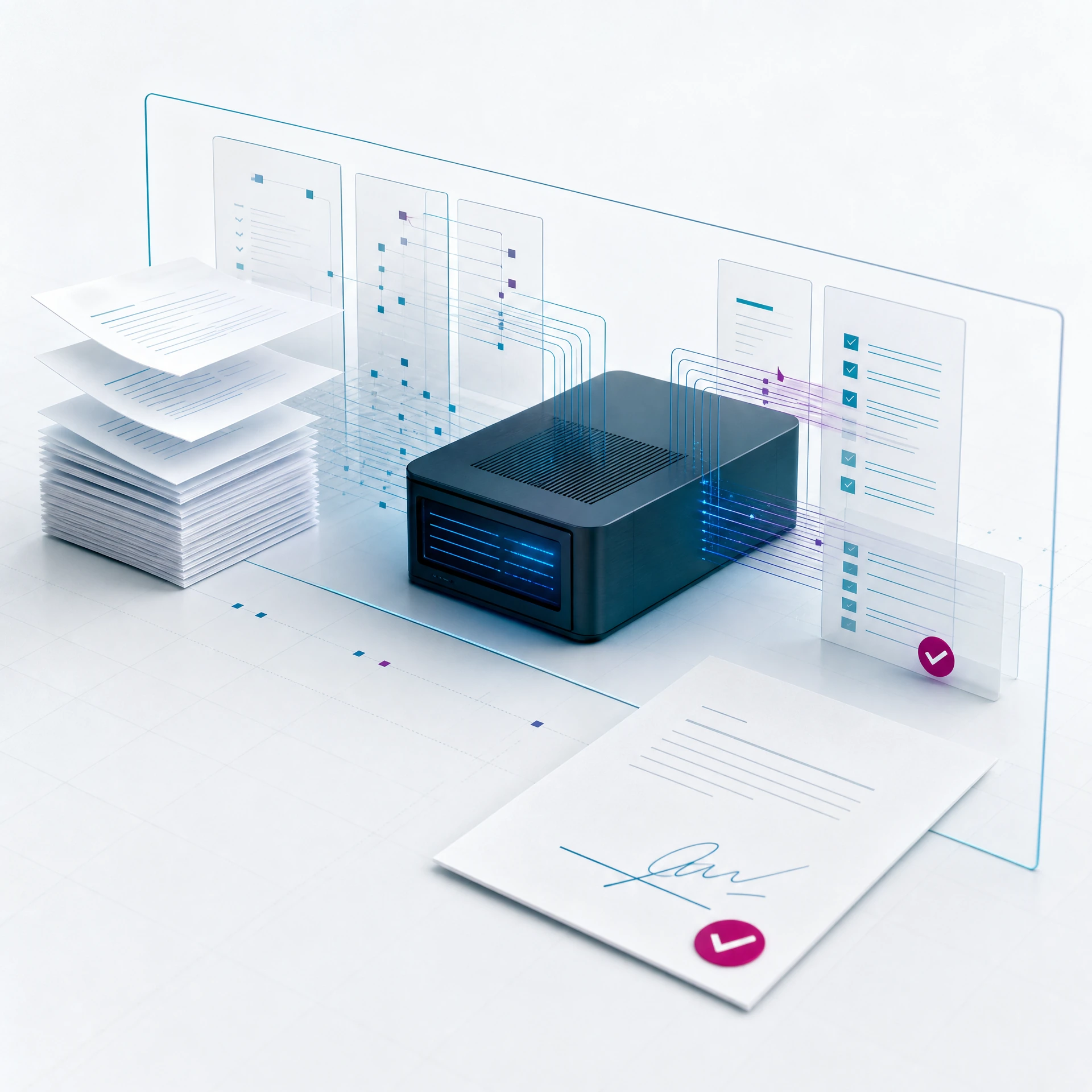
Contracts, addenda, framework conditions and specialist documents are structured as one coherent approval matter.
The AI highlights discrepancies, missing contract points, open questions and relevant calculations in a traceable way.
Information is consolidated into a reviewable basis so the responsible person can assess it specifically.
Professional assessment, legal classification, decision and legally binding approval remain entirely with people.
Human in the loop
Information preparation by AI. Assessment, decision and approval by people.
Measurable effect
In the case described, the time required for the work step was reduced from around 20 to about 5 minutes. The real value lies not only in the time saved, but in a basis for decisions that is available earlier and is traceable.
Case-specific values. Not a guaranteed saving or a legal assessment.
Data sovereignty
With contract drafts, expert reports, audit reports, citizen data, personnel files and internal matters, it is not only about efficiency. It is about trust, data sovereignty and the question of whether sensitive information leaves the organization.
Laigo GPT describes its approach as local processing within the protected network. This architecture can create the basis for responsibly using AI support even in confidential approval processes. The specific data-protection, compliance and legal review nevertheless remains part of the organization-specific rollout.
A transferable use case
The real-world case comes from a municipal administration. The underlying problem, however, affects almost every organization in which a document is produced by one person and approved by another person with responsibility.
The larger the organization and the higher a decision-maker's responsibility, the more often decisions must be made on the basis of extensive, fragmented information. Local AI can prepare contracts, guidelines and other relevant documents in a reviewable context.
FAQ
Concrete answers on responsibility, local processing and how to read the real-world case.
AI can bring together relevant information from contracts, addenda, guidelines and other documents, highlight open points and prepare a reviewable basis of information. It replaces neither the professional nor the legal assessment.
No. The final decision, the approval and the responsibility remain with the responsible decision-maker or specialist. The AI supports the preparation and makes information as well as possible inconsistencies accessible faster.
With confidential documents, it is decisive where data is processed. A locally operated solution can process data within the organization’s protected network. The specific data-protection, compliance and governance assessment must nevertheless always fit the respective organization and use case.
No. The span from around 20 to about 5 minutes comes from a documented use case. The actual effect depends on document structure, data quality, process design, configuration and organizational integration.
The use case is suitable wherever people have to review complex matters before a responsible approval. This includes public administrations, regulated companies, industry, financial service providers, healthcare organizations and other institutions with demanding document and decision processes.
The strategic gain
A secure, locally operated AI can make complex matters graspable faster, prepare relevant information in a structured way and surface potential inconsistencies early.
Responsibility remains entirely with people. But the path to a well-founded decision becomes more transparent, more secure and more efficient.
Laigo GPT Use Cases
Perhaps now is exactly the right moment to rethink this process.
Your data privacy is important to us.
The details you provide will only be used for the purpose they were intended for. Read more in our Privacy Policy.
Your data privacy is important to us.
The details you provide will only be used for the purpose they were intended for. Read more in our Privacy Policy.
*Mandatory Field
Data privacy is very important to us!
Details provided, will only be used for the purpose they were intended for. Read more about our commitment and Privacy Policy
*Mandatory Field
Data privacy is very important to us!
Details provided, will only be used for the purpose they were intended for. Read more about our commitment and Privacy Policy